
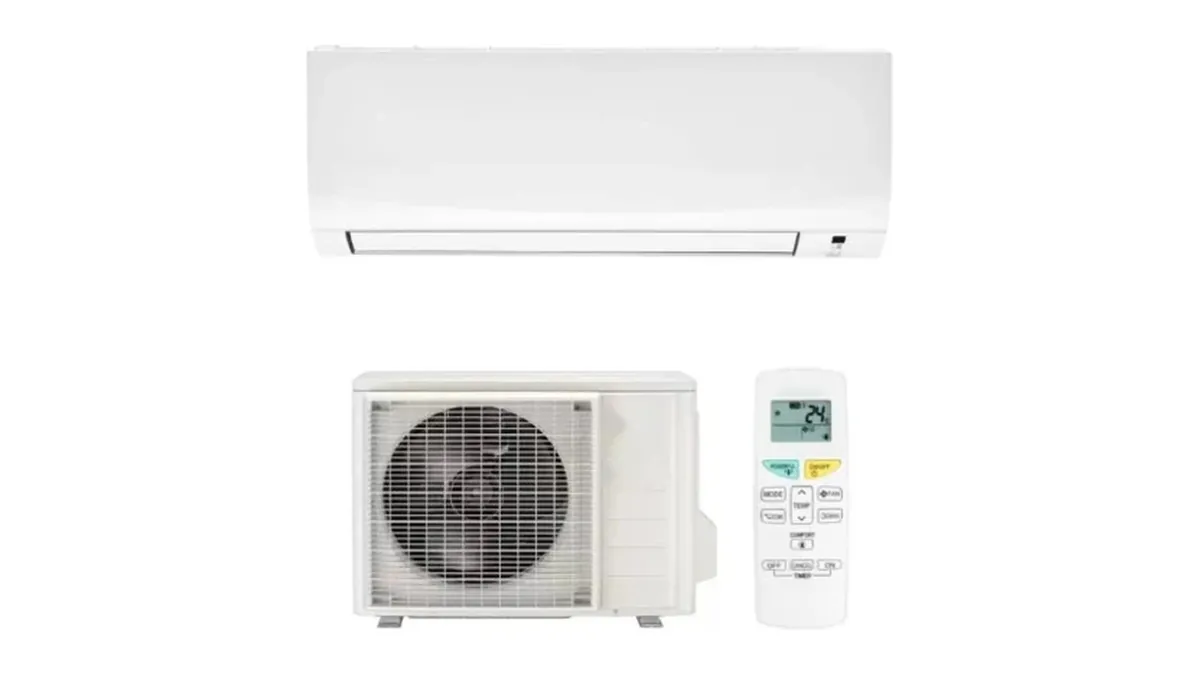
Almost everyone who wants to air-condition three or four rooms reaches the same fork in the road: should a separate split air conditioner be fitted in each room, or a multi system connected to a single outdoor unit? Both solutions work well when done correctly. The difference shows up in the facade, budget, fault risk and usage habits.
What is a multi air conditioner, and how does it differ from a split air conditioner?
A multi air conditioner is a system in which usually two to five indoor units are connected to a single outdoor unit. Each indoor unit has its own remote and temperature setting, but all share the same compressor and the same outdoor unit. The indoor units can be wall-mounted, cassette, ducted or console types, and can be mixed in the same system.
A split air conditioner, on the other hand, is an independent system pairing one indoor unit with one outdoor unit. Four rooms require four separate outdoor units. Each has its own refrigerant circuit, its own compressor and its own electrical supply. You can find details of split systems on our split air conditioner page.
Comparison: which one leads on which criterion?
The differences between the two systems are clearest when viewed side by side. The table below summarizes the general trend for a four-room home; the exact result is determined at the site survey according to unit selection and building conditions.
| Criterion | Multi air conditioner | Separate split air conditioners |
|---|---|---|
| Number of outdoor units | 1 | As many as the number of rooms |
| Facade appearance | Clean, a single unit | Crowded; building management permission can be an issue |
| Initial investment | Usually higher | Usually lower |
| Effect of a fault | All rooms stop if the outdoor unit fails | Only the room concerned is affected |
| Part-load efficiency | May drop when running a single room | Each unit works for its own room |
| Mode selection | All rooms in the same mode (heating or cooling) | Each room independent |
| Piping | Long runs, careful planning | Short, simple runs |
| Later expansion | Limited by outdoor unit capacity and number of ports | A new unit can be added whenever you want |
When is a multi air conditioner the better choice?
A multi air conditioner is the best choice in homes where outdoor unit space is limited or the facade must be protected. Where building managements allow only a single outdoor unit on the facade, where the balcony is narrow, or where the building has a historic character, it is practically the only option.
01If facade and balcony space is limited
In homes with no place to hang four outdoor units, a single multi outdoor unit can be gathered on the roof, on a terrace or in a technical niche. This both preserves the appearance and leaves the balcony usable.
02If the rooms are usually used together
In a family where the living room and bedrooms run together in the evenings, a multi outdoor unit runs close to the load range it was designed for and is efficient. Inverter multi systems adjust their capacity according to the number of indoor units switched on.
03If you are sensitive to noise
Instead of several outdoor units running in front of bedroom windows, placing a single unit at a suitable spot reduces noise complaints.
When do separate split air conditioners make more sense?
Separate split air conditioners generally make more sense in homes where rooms are used at different times and for different purposes, and where there is no problem finding facade space for outdoor units. Each room running independently provides both flexibility of use and security.
The most important advantage is independence from faults. If the compressor or board of a multi system's outdoor unit fails in mid-July, no room in the house cools. With separate split air conditioners, only the room of the faulty unit is affected and the family can cool off in the other rooms.
Part load is also an important matter. For example, when only the study needs 9,000 BTU, running a 24,000 BTU multi outdoor unit can fall outside the most efficient range even if it is an inverter. In homes where only one room is used during the day, separate splits can be more advantageous in terms of energy. You can find the right capacity for each room with the calculation in our how many BTU air conditioner should I buy article.

In a multi system, all the indoor units run in either heating or cooling mode at the same time. It is not possible to want cooling in one room and heating in another; this becomes noticeable in the shoulder seasons.
What should you pay attention to during installation?
The success of a multi air conditioner depends largely on correct planning of the piping. Every manufacturer sets limits on the total pipe length between the outdoor unit and the indoor units, the single-run length and the height difference. Exceeding these limits can lead to loss of capacity, oil return problems and compressor failure.
The sum of the indoor unit capacities must be compatible with the outdoor unit capacity, and the combination table permitted by the manufacturer must not be exceeded. On long runs, an additional refrigerant charge is needed, and this amount is calculated from the manufacturer's value according to pipe length. After installation, the nitrogen pressure test, vacuum and leak check must not be skipped.
Which one is right for your home?
We inspect your floor plan and outdoor unit location on site and present the multi and split options side by side.
The same rules apply to separate split air conditioners, but because the runs are short and simple, the margin for error is lower. In both systems, the drain slope, an outdoor unit position where it can take in air, and an electrical line of a cross-section suitable for the unit's power are required.
With four rooms and more, a third option: mini VRF
In large homes, villas or small offices with five or more rooms, mini VRF systems are a more advanced alternative to the multi air conditioner. VRF is a system that precisely adjusts the refrigerant flow to the needs of each indoor unit and allows longer pipe distances and more indoor units. The initial investment is higher, but part-load efficiency and control options are clearly improved. For details, take a look at our VRF air conditioner page.
Quick decision guide
If the outdoor unit location is a problem, the rooms are used together and the facade matters, choose a multi air conditioner. If there is no facade problem, the rooms are used at different times and protection against faults is the priority, separate split air conditioners are more suitable. If there are five or more indoor units or a long pipe distance, consider mini VRF.
YOİ Mühendislik teams carry out the site survey, design and installation of multi, split and VRF systems on all brands. Based on your home's plan, the outdoor unit location and your usage habits, we present the two options side by side with their costs; the cost is determined at the site survey. Regular maintenance is also important to keep efficiency after installation; our air conditioner maintenance article guides you on this.
Frequently asked questions
How many indoor units can be connected to a multi air conditioner?
In home multi air conditioners, generally 2 to 5 indoor units can be connected, depending on the outdoor unit model. For more than that, mini VRF systems are used.
Can a single room be run on a multi air conditioner?
Yes, each indoor unit can be switched on and off independently. However, because the outdoor unit has a large capacity, efficiency when running a single room may be lower than with a separate split air conditioner.
What happens if the outdoor unit of a multi air conditioner fails?
Because all the indoor units are connected to the same outdoor unit, no room can cool or heat until the fault is fixed.
Is a multi air conditioner more expensive, or a split?
At the same total capacity, the initial investment for a multi air conditioner is usually higher. The exact cost is determined at the site survey according to unit selection, pipe length and installation conditions.