
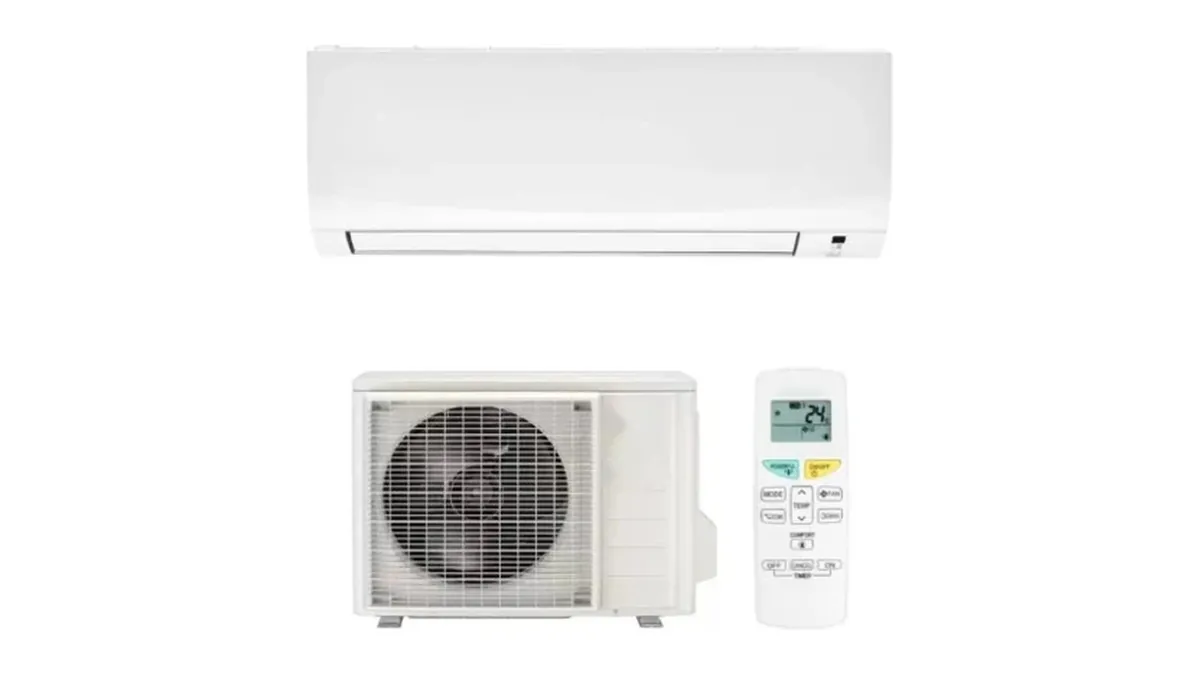
Electricity and natural gas bills are discussed again every winter, and the same question comes up: is using the air conditioner for heating cheaper than running the combi boiler? The exact answer varies from home to home, because the calculation rests on three variables: the efficiency of the air conditioner, the outdoor temperature and the unit prices of the two energies that day. The good news is that you can do the calculation yourself in a few minutes.
How does an air conditioner work when heating?
An air conditioner in heating mode is a heat pump that collects heat from the outside air with the help of refrigerant and carries it indoors. Electricity is used not to generate heat but to run the compressor and move the heat. For this reason, an air conditioner can deliver more than 1 kWh of heat for every 1 kWh of electricity it uses.
This ratio is called COP (Coefficient of Performance). An air conditioner with a COP of 3 produces about 3 kWh of heat from 1 kWh of electricity. Electric heaters and oil-filled radiators have a COP of 1; they convert the electricity they use into heat one to one. The air conditioner's advantage in heating comes entirely from this difference.
How does a combi boiler produce one unit of heat?
A combi boiler produces heat by burning natural gas, and its efficiency is below 1 or very close to 1. When one cubic meter of natural gas burns, about 9-10 kWh of heat is released. Condensing boilers transfer most of this to the water; in older, poorly maintained boilers the loss is greater.
For a practical calculation, the following assumption works: a well-running condensing boiler delivers about 8.5-9.5 kWh of usable heat to the home from 1 m³ of natural gas. When you combine this number with the price per m³ on your bill, you find the cost of 1 kWh of heat produced with natural gas.
How do you do the calculation for your own home?
To find out whether heating with an air conditioner is cheap, it is enough to compare the cost of 1 kWh of heat from the two energies. Take the price per kWh of electricity and the price per m³ of natural gas (taxes included) from your bills, then do the following two calculations:
- Cost of 1 kWh of heat with an air conditioner = electricity price per kWh ÷ COP
- Cost of 1 kWh of heat with a combi boiler = natural gas price per m³ ÷ 9 (approximate usable kWh per m³)
Whichever is smaller, that energy is cheaper under those conditions. You can also set up the same calculation the other way around: divide the electricity price per kWh by the cost of 1 kWh of heat from natural gas. The resulting number is the break-even COP value. If your air conditioner's COP that day is above this number, the air conditioner is more economical; if it is below, the combi boiler is.

If there is a tiered tariff or a limit overage on electricity, do the calculation with the upper-tier price. Heating with an air conditioner in winter increases your consumption and may push you into a higher tier.
What happens to the air conditioner's efficiency as the outdoor air gets colder?
As the outdoor temperature falls, the air conditioner's COP also falls, because there is less heat to collect from outside and the compressor works harder. Exact values vary by model and the manufacturer's test data; the table below shows the general trend for a good inverter split air conditioner.
| Outdoor temperature | Typical COP range | Comment |
|---|---|---|
| +7 °C and above | 3,5–4,5 | The air conditioner is generally clearly advantageous |
| 0 to +7 °C | 2,5–3,5 | Still advantageous in most tariffs |
| -7 to 0 °C | 2–2,5 | Approaches break-even depending on the price ratio |
| Below -7 °C | 1.5-2 and below | Capacity drops; the combi boiler is often more economical |
Which heating suits your home?
We inspect the heat loss and the existing installation on site and recommend an air conditioner, a heat pump or a combined solution.
There is one more loss in cold weather: the outdoor unit's coil ices up and the air conditioner defrosts at regular intervals. During this time no warm air comes from the indoor unit and energy is spent on melting the ice. In cities with harsh winters such as Ankara, Erzurum and Sivas, the air conditioner's average efficiency in January and February therefore falls below what the catalog shows.
Other factors that change the result
01The unit's class and technology
Inverter air conditioners adjust their capacity to demand, so they are noticeably more efficient in heating than fixed-speed (on/off) air conditioners. The SCOP value on the label shows the unit's average efficiency over a whole heating season and is more realistic for comparison than a single COP value. We covered how big the advantage really is in our inverter air conditioner savings article.
02The area being heated
A combi boiler heats the whole home, while an air conditioner heats only the room it is in. If you spend most of the day in a single room, heating that room with the air conditioner and turning down the radiator valves in the other rooms can reduce the total cost. Heating the whole home with air conditioners requires an indoor unit of suitable capacity in every room.
03Maintenance condition
The heating efficiency of an air conditioner with a clogged filter, a dirty coil or low refrigerant drops noticeably. The same is true for a combi boiler. Both units must be well maintained before you compare them; otherwise the calculation is misleading.
04Comfort
An air conditioner carries heat with air; hot air rises toward the ceiling and temperature layering can occur in the room. Radiators and underfloor heating give a more evenly distributed heat. Pointing the air conditioner's high louvers downward and leaving the fan on auto improves comfort.
How does the tiered natural gas tariff change the calculation?
Since April 2026, a province-based tiered tariff has applied to residential natural gas. Monthly consumption limits were set for each province according to its climate and published on the BOTAŞ website. Consumption below the limit is billed with higher support, while the portion above the limit is billed with lower support, at a price close to cost (BloombergHT).
That is why you should do the calculation above twice: once with the within-limit natural gas price and once with the above-limit price. If your home exceeds the limit in the winter months, the portion above the limit has a lower break-even COP value, and the air conditioner becomes advantageous across a much wider temperature range. The most efficient use is often this: the combi boiler up to the month's limit, and the air conditioner in the room you live in on mild days and as you approach the limit. For a detailed comparison: heat pump or combi boiler; for the right settings: heating with an air conditioner guide.
The most sensible solution: using both systems together
For most homes, the most economical path is to see the air conditioner and the combi boiler as complements rather than rivals. Using the air conditioner in autumn, spring and the mild days of winter, and leaving the main heating to the combi boiler when the outdoor temperature drops below zero, means each energy is used in the range where it is most efficient. Once you have calculated your break-even COP value, you will also know at what temperature to switch.
In detached homes and summer houses without natural gas, an air-source heat pump working with a radiator or underfloor heating system is a strong option. A heat pump works on the same principle, but it transfers the heat to water, and there are models designed to operate at low outdoor temperatures.
What to look for when choosing an air conditioner for heating
If you plan to use the air conditioner in winter too, do not choose by cooling capacity alone. Look at the heating capacity on the label, the SCOP value and the lowest operating temperature stated by the manufacturer. Models designed for cold climates can operate at -15 °C and below. To find the right capacity for your room size, you can use our guide how many BTU air conditioner should I buy.
At YOİ Mühendislik, we assess your home's heat loss, your usage habits and your existing installation on site, and recommend an air conditioner, a heat pump or a solution that uses both together. Unit selection and cost are determined at the site survey; you can review the options on our heat pump page.
Frequently asked questions
How much does heating with an air conditioner raise the electricity bill?
The increase depends on the air conditioner's capacity, its COP value, the hours of use and the outdoor temperature. For a precise estimate, multiply the unit's heating power consumption by the daily hours of use and calculate with your electricity unit price.
What is COP?
COP is the coefficient of performance that shows how many kWh of heat an air conditioner produces for every 1 kWh of electricity it uses. An air conditioner with a COP of 3 delivers about 3 kWh of heat from 1 kWh of electricity.
Does an air conditioner heat at below-zero temperatures?
Most inverter air conditioners heat below zero as well, but their efficiency and capacity drop and defrost times increase. Depending on the manufacturer, cold-climate models can operate at -15 °C and below.
Which is cheaper, an air conditioner or an electric heater?
An air conditioner is cheaper in almost every condition. An electric heater produces 1 kWh of heat from 1 kWh of electricity, while an air conditioner can produce 3-4 kWh of heat in mild weather.